

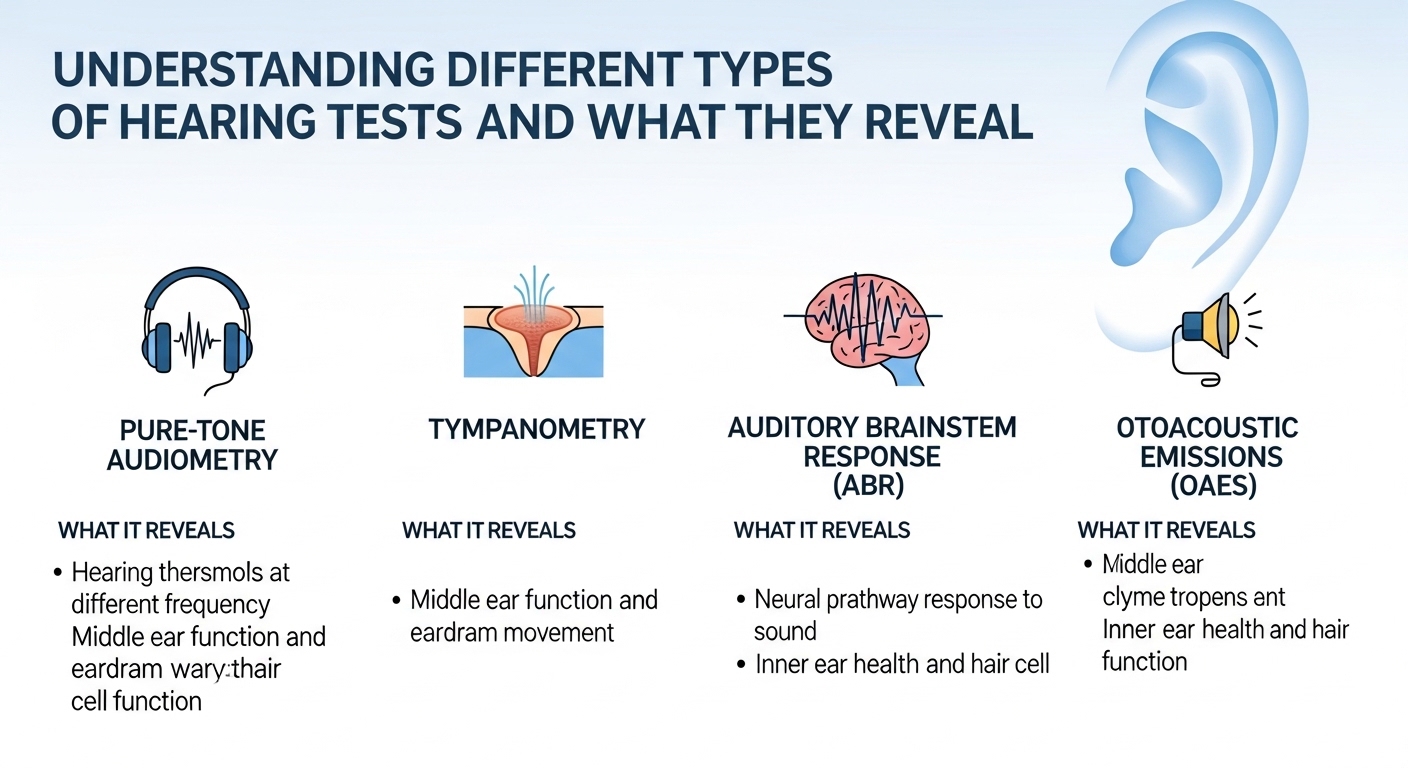
Our ears are remarkable instruments. Every day, they help us tune in to laughter, conversations, music, and the gentle rustle of nature. But just like any other part of our body, hearing can change over time—sometimes subtly, sometimes noticeably. That’s why understanding different types of hearing tests and what they reveal can empower you to take charge of your hearing health.
In this post, we’ll take you on a friendly tour of common hearing tests, explain what each one can tell you, and share real-world examples so you can see how these assessments play out in daily life.
Why Hearing Tests Matter
Imagine you’re on a busy city street. Engines rumble, horns honk, people chatter, and yet you can still carry on a conversation with a friend. Hearing isn’t just about volume—it’s about clarity and focus. When someone begins to lose their ability to hear certain frequencies, they may still “hear” sounds, but miss important details, especially in noisy environments.
Hearing loss doesn’t just impact communication—it can influence confidence, relationships, and even safety. Drivers need to hear sirens, parents need to notice a child’s call from another room, and professionals in industries like construction or hospitality rely on acute hearing to perform their best.
Hearing tests are the first step toward understanding what’s going on beneath the surface. They help clinicians pinpoint not only if there’s an issue, but what kind of issue it might be.
The Basics: Pure-Tone Audiometry
One of the most common hearing tests is pure-tone audiometry. In this assessment, you wear headphones and listen for a series of tones at different pitches and volumes. Each time you hear a tone—even if it’s very faint—you signal to the examiner (often by pressing a button).
This test maps out the softest sounds you can hear across a range of frequencies. The result is shown on an audiogram—a chart that visualises hearing thresholds.
What This Test Reveals
Pure-tone audiometry can tell you:
- Which frequencies do you struggle with, such as high-pitched sounds (like birdsong or children’s voices) or low-pitched sounds (like deep musical notes)?
- The degree of hearing loss ranges from mild to profound.
- Whether hearing loss is symmetrical (similar in both ears) or different from one side to the other.
For example, a musician might notice a drop in their ability to hear higher pitches after years of performing in loud venues. An office worker, on the other hand, might notice a gradual general decline that makes phone conversations harder to follow.
Speech-In-Noise Testing: Real-Life Hearing in Action
Hearing a tone in a quiet room is one thing—but what about following a conversation in a bustling café? That’s where speech-in-noise testing comes in.
In this test, you’ll hear sentences mixed with background noise. The goal isn’t just to detect sound, but to understand speech when there’s competition from other sounds.
Why It’s Useful
Speech-in-noise tests mimic everyday listening environments. They’re especially helpful for:
- People who feel they hear okay in quiet spaces but struggle in noisy settings
- Older adults whose primary complaint isn’t volume but clarity
- Workers in hospitality, education, or aviation, where accurate listening matters amid background noise
For instance, a café barista may be able to identify tones perfectly in a quiet booth but find it nearly impossible to catch a customer’s order during a busy Sunday brunch rush. This test helps clinicians identify that type of functional difficulty.
Tympanometry: Checking the Middle Ear
Not all hearing issues stem from the inner ear. The middle ear—the space behind the eardrum containing tiny bones that transfer sound—can also influence hearing.
Tympanometry measures how well the eardrum moves in response to changes in air pressure. A small probe placed in the ear canal creates changes in pressure and measures how the eardrum responds.
What It Shows
This test helps detect:
- Fluid in the middle ear (common after a cold or ear infection)
- Eustachian tube dysfunction, which can cause pressure and muffled hearing
- Perforations or scarring of the eardrum
People who experience sudden muffled hearing after a flight or a swim might benefit from this assessment. It’s also a standard part of evaluations for children with recurrent ear infections.
Otoacoustic Emissions: Inner Ear (Cochlea) Health
Deep inside your ear lies the cochlea, a spiral-shaped structure filled with thousands of tiny hair cells. These cells convert sound vibrations into electrical signals for the brain. When they’re healthy, they even produce faint sounds of their own called otoacoustic emissions.
During an otoacoustic emissions (OAE) test, a small probe emits sounds into the ear and listens for these echoes. A lack of response can indicate that cochlear hair cells aren’t functioning properly.
Who Might Need This Test
- Newborns are part of early screening
- People exposed to loud noise over long periods, such as construction workers or musicians
- Anyone with suspected sensory hearing loss
Because this test doesn’t require an active response (you just sit quietly while the machine measures), it’s useful for infants and others who might struggle with tone-based tests.
Auditory Brainstem Response: Beyond the Ear
Sometimes, hearing issues aren’t about the ear itself but how the brain processes sound. The Auditory Brainstem Response (ABR) test measures electrical activity from the inner ear to the brainstem in response to sound.
Tiny sensors are placed on the scalp, and sounds are played through earphones. The equipment records how the auditory pathway responds.
What It Helps Detect
- Neurological issues affecting hearing pathways
- Tumours on the auditory nerve
- Developmental issues in infants
This test is especially relevant for babies who can’t participate in behavioural testing or for adults with unexplained hearing difficulties that don’t show up on other tests.
Putting It All Together: A Clearer Picture
Each of these tests offers a piece of the hearing puzzle:
- Pure-tone audiometry tells you what you hear and where
- Speech-in-noise tests show how you hear in real-life situations
- Tympanometry checks the health of your middle ear
- Otoacoustic emissions look at the inner ear sensory cells
- Auditory Brainstem Response evaluates the neural pathway
Together, they help clinicians build a comprehensive understanding of your auditory system—and how best to support it.
If you’re curious about what a hearing assessment might involve in your area, check resources like www.audihearing.com.au for information on services that offer a full range of these evaluations.
Real-World Examples: Hearing Tests in Everyday Life
Let’s bring these ideas out of the clinic and into familiar situations:
- Office Worker “Missing Parts of Conversations”
Sarah works in an open-plan office. She finds herself constantly asking colleagues to repeat themselves, especially during calls. A speech-in-noise test revealed that, while she can detect tones well, she struggles to distinguish speech in busy sound environments. With this information, she and her audiologist explored solutions to improve clarity. - Musician with Gradual Pitch Loss
Tom is a drummer who’s played in pubs for years. He noticed he couldn’t hear high notes as clearly as before. Pure-tone audiometry confirmed a mild high-frequency loss, likely linked to long-term exposure to loud music. With custom hearing protection and regular monitoring, he’s now managing his hearing health proactively. - Child with Recurrent Ear Infections
Six-year-old Lily kept getting ear infections, and her parents noticed she sometimes ignored sounds at home. Tympanometry showed fluid buildup in her middle ear between infections. With that insight, her doctor recommended a treatment plan that ultimately helped restore her hearing comfort.
Taking the Next Step
Hearing changes are common—and treatable when caught early. If you or someone you care about has noticed difficulty hearing in certain situations, fluctuating hearing, or persistent ringing (tinnitus), starting with a comprehensive hearing assessment is a smart move.
Understanding different types of hearing tests and what they reveal doesn’t just help you make sense of clinical terms—it gives you confidence to ask questions and be an active participant in your care.
Whether for peace of mind, work efficiency, or simply enjoying everyday sounds with loved ones, hearing health is a vital part of life worth paying attention to.